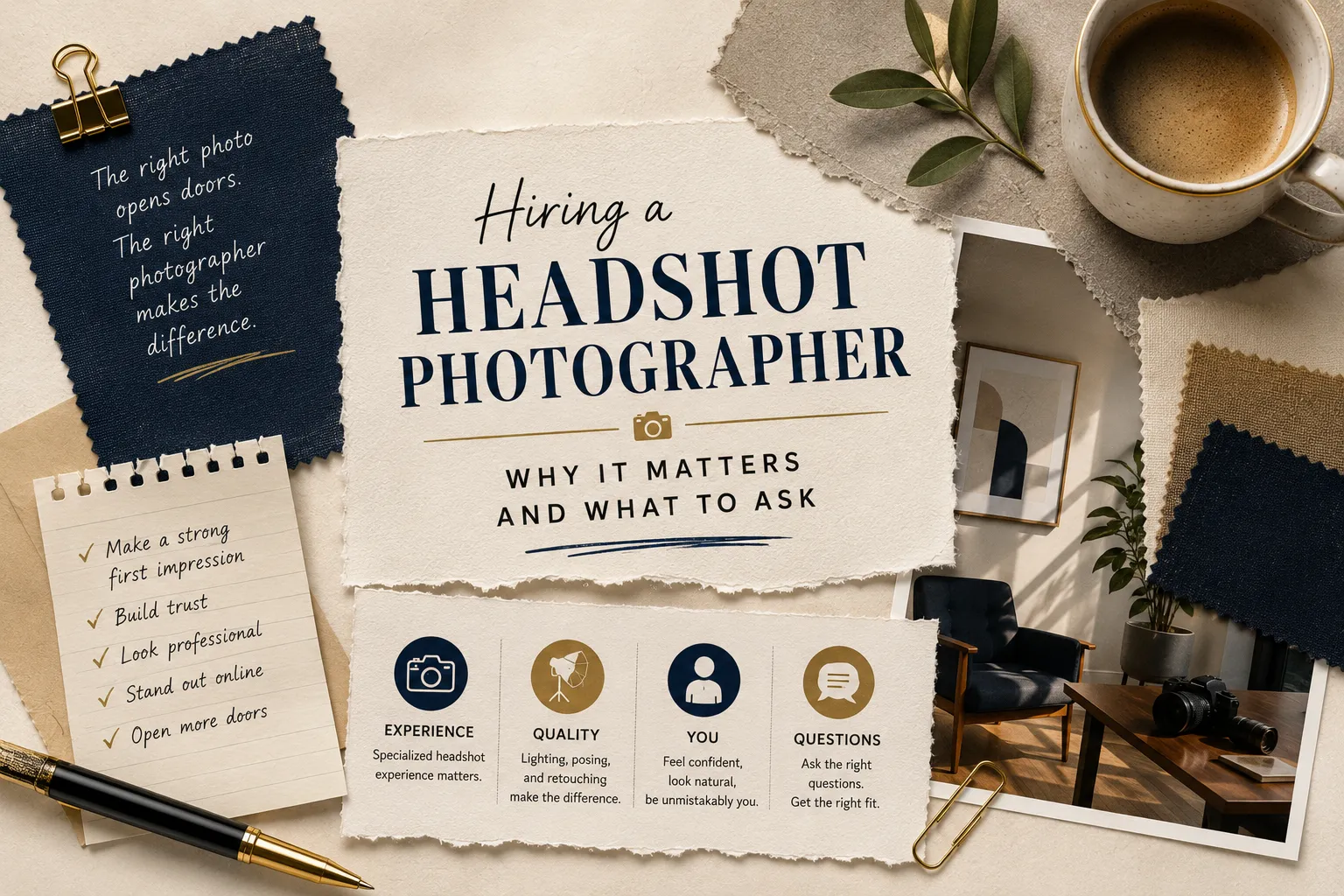
A headshot is one of the longest-lived pieces of marketing a professional or small business will ever commission. It sits on a LinkedIn profile, a firm bio page, a speaking bio, and the directory listings that surface whenever someone searches your name. For years. After more than 45 years photographing Tampa Bay's law firms, corporate teams, and professionals, the patterns are consistent: the clients who think carefully about who they hire end up with portraits they keep using; the ones who treat the decision casually end up paying twice. This is the practical version of that conversation.
Why a headshot actually moves the needle
Princeton's Alex Todorov and Janine Willis demonstrated in 2006 that viewers form judgments about trustworthiness, competence, and likability from a face in roughly one tenth of a second, and that those snap judgments correlate strongly with the more considered judgments people make after longer exposure. Your headshot is doing most of the credibility work before a prospect ever reads a word of your bio. LinkedIn's own published data reinforces it: profiles with a professional photo receive roughly fourteen times more views and around nine times more connection requests than profiles without one. PhotoFeeler, an independent service that crowd-rates business headshots on competence, likability, and influence, has reported that small differences in lighting, expression, and framing shift a viewer's rated competence score by double-digit percentage points. In my experience photographing Tampa Bay attorneys and executives, the headshot is almost always the single highest-leverage piece of marketing they own, and almost always the one they have thought about least.
What "professional" actually means in a headshot context
Not all paid photography produces what a working professional needs. A real executive portrait has specific, repeatable properties. The lighting is studio-grade and flattering without looking artificial, which typically means a key light placed deliberately, fill to control shadow density, and either a hair light or a controlled background separation. The composition is intentional, with clean backgrounds that crop into the circles LinkedIn uses, the banners websites use, and the rectangles directories use. The style is consistent across multiple team members. The direction during the session produces a present expression rather than a frozen one. And the retouching is subtle, cleaning up distractions without erasing the personality underneath. My opinion, after watching the industry change for four decades, is that this last property, restrained retouching, is the one that ages best; the heavily stylized look that was popular five years ago is already starting to look dated, and the headshots that still work are the ones that look like the person.
Why specialization matters more than years of general experience
A wedding or event photographer can be enormously talented at storytelling and crowd management, but a corporate headshot is a different craft, with tighter lighting, deliberate posing, and a clear sense of what professionals in different industries are expected to look like. When I see a portfolio dominated by weddings with a small headshot section appended, that tells me the photographer is solving a different problem than the one a Tampa Bay law firm is bringing them. The right answer to "how long have you been shooting headshots specifically?" is concrete: a real number of years, the kinds of industries they work in regularly, and the firms or companies they have photographed. This studio has been focused on Tampa Bay's professional community since 1980, and the only reason we keep getting referred into the same law firms generation after generation is that the focus has never drifted.
Corporate photographer, business photographer, or headshot specialist: what you actually need
The labels blur together in a search bar, and it is worth knowing what you are actually looking for. A "corporate photographer Tampa Bay" listing often covers a wide range of commercial work, events, conferences, product shots, executive portraits, while a "business photographer Tampa" might lean toward branding sessions and marketing imagery. A headshot specialist is the narrow case: someone whose core craft is the controlled, repeatable executive portrait that has to look consistent across an entire team and hold up on a bio page for years. If what you need is a unified set of professional headshots for a firm or company, the broad corporate or business photographer category will sometimes deliver it and sometimes treat it as a sideline; the question worth asking is how much of their actual day-to-day work is headshots specifically. This studio sits firmly in the specialist category for executive and team headshots, which is why the lighting, posing, and on-location workflow are built around that one job rather than bolted onto a general commercial business.
What to look for in a portfolio
A specialist will have a current portfolio that includes subjects similar to you, similar industry, similar age range, similar setting. Beyond style, consistency is the property that matters most for a firm or team. Does the lighting hold steady across different subjects, or does the quality jump around? Are the backgrounds clean and similar from portrait to portrait? Do the expressions feel like genuine moments or canned smiles? For a law firm bio page or a corporate team page, consistency matters more than any single image, because the website visitor is looking at the page as a whole, not at individual photos. A recent project that comes to mind: a Tampa downtown firm with forty-plus attorneys who wanted their bio page to look unified for the first time in a decade. The previous photos were from six different photographers and three different decades, and the page communicated exactly what you would expect. One on-location morning solved it.
Whether on-location is right for your situation
For corporate teams and busy executives, on-location is almost always the better choice. It removes the logistics of getting twenty people to a studio across multiple days, and it keeps the session in the rhythm of the workday. A photographer set up for on-location work brings full studio-grade lighting, modifiers, and a portable backdrop to your office. They do not depend on the room's existing light. Setup is about twenty minutes; most conference rooms work fine. The on-location service has been the foundation of this studio since 1980 because it solves the real problem firms face: getting the entire team photographed in a single morning without anyone leaving the building. For solo professionals, the calculus shifts slightly, but for any group of three or more, on-location is almost always the right answer.
What retouching scope and style to ask about
Retouching has an outsized effect on the final result, and it is the question most clients forget to ask. Confirm three things directly: whether retouching is included or charged separately, how many images receive full retouching, and what the stylistic approach is. The right answer for a professional headshot is subtle and natural, cleaning up distractions without erasing the person. My opinion on this is firm: a headshot should look like the person on their best day, not a smoothed-out generic version. The same restraint we apply on heirloom restoration work, where the goal is to preserve who someone was rather than reinvent them, is the same restraint a business headshot deserves. If every face in a portfolio looks suspiciously smooth, that is a style decision worth making consciously before it ends up next to your name on a firm website.
What deliverables and usage rights to confirm in writing
Pin this down before booking. Some photographers deliver a single fully retouched portrait. Some deliver a handful. Some include unrestricted commercial usage; others charge separately for use on a firm website, press release, or social media. For a business headshot, you typically want full commercial usage rights on the agreed-upon images, with no surprise licensing fees later. A clear photographer will spell this out without being asked twice. We hand over retouched high-resolution files suitable for LinkedIn, firm websites, press, printed materials, and any other reasonable business use, with full rights, because that is what business clients actually need; anything less creates a friction point years down the road when someone tries to use their own headshot in a new context.
What turnaround time is realistic
For a single executive, a week to ten business days is reasonable. For a corporate team session, two to three weeks is common because there is more retouching to complete. Rush options should exist for the rare moments you really need them. A specialist with steady volume can give you a real timeline; a hobbyist tends to be optimistic and then late. If the photographer hesitates when you ask, that is a useful signal. We commit to a delivery window before any session starts and treat it the same way as the session itself.
How nervous subjects should be handled
Most people, even confident executives, tense up in front of a camera. The right photographer notices it immediately and adjusts: simpler direction, slower pacing, more conversation, specific breathing cues, small posing adjustments. A vague answer like "I just put them at ease" is a yellow flag. After 45+ years, this is the part of the work most photographers underestimate and most subjects need the most. I have photographed senior partners who had successfully argued in front of state supreme courts and were still nervous about a fifteen-minute headshot session. The work is not making someone look confident; it is making the actual confidence they have show up on camera, which requires removing the small distractions that are blocking it. That is technique you build over decades, not over weekends.
What happens if you do not like the result
This is the question people often hesitate to ask, and it is the one most worth asking. A reputable headshot photographer should answer it directly, usually with a reshoot policy or a targeted re-edit on specific images. Asking the question is a sign you are taking the decision seriously, not a challenge, and an evasive answer tells you something useful before any money changes hands. Our policy is straightforward: if a portrait is not working, we figure out why and fix it, whether that is a re-edit, a partial reshoot, or in rare cases a full one. A headshot that sits on a firm website for the next three years has to be one the subject is genuinely happy with, and the cost of getting that right is small compared to the cost of getting it wrong.
Ready to talk?
If you are evaluating photographers for an executive headshot, a law firm refresh, or a corporate team session anywhere in the Tampa Bay area, contact Bob for a direct conversation. You can also read about Bob's background and the decades of work that have made this studio Tampa Bay's quiet standard for professional portraits.