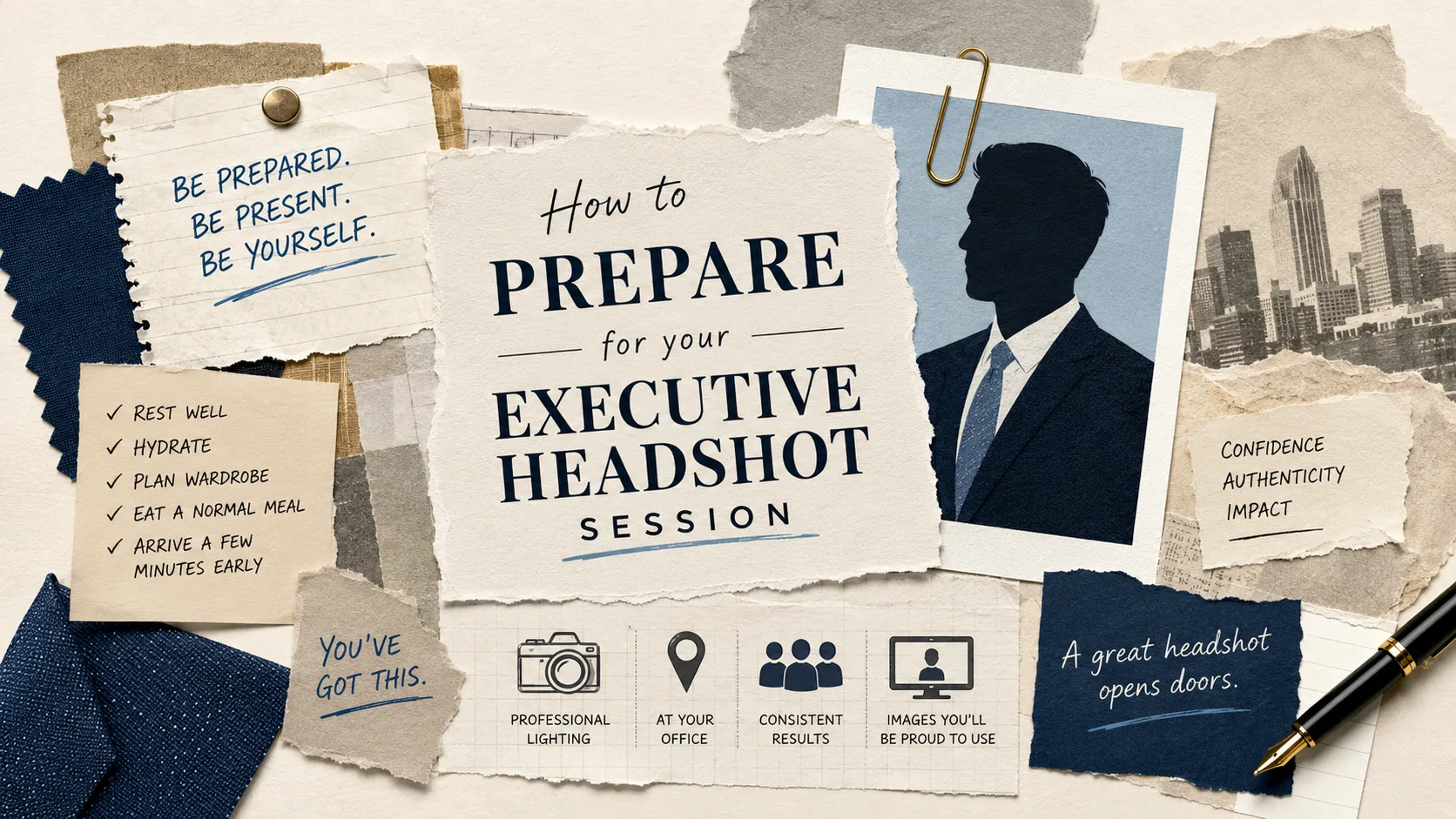
The day of a headshot has a way of feeling bigger than it is. After 45+ years of photographing Tampa Bay's law firms, corporate teams, and professionals, the pattern is consistent: the people who arrive prepared, even slightly, walk away with portraits they actually like. Preparation is not about effort. It is about removing the small distractions that pull your attention away from being present in front of the camera. The notes below are drawn from thousands of sessions and from what photographers, dermatologists, and stylists who specialize in business portraiture broadly agree on.
How far in advance to start preparing
The honest answer is roughly a week, with one or two decisions made earlier. Sleep, hydration, and wardrobe are not things you can fix the morning of. Puffiness around the eyes, the most common reason a subject does not like their own photos, is almost entirely a function of sleep, hydration, and sodium over the two or three nights before the session. A normal sleep schedule for two consecutive nights, water above your baseline that whole week, and lower-than-usual salt and alcohol the day before is the same protocol used by people who appear on camera professionally. In my opinion, the single biggest determinant of a good session, after the photographer, is whether the subject slept properly the night before.
What to wear, and why color matters
Solid, mid-tone colors photograph best across nearly every skin tone and lighting setup, navy, charcoal, deep green, burgundy, the kinds of colors most attorneys and executives already own. The reasons are technical. Bright white tends to clip on a sensor under studio lighting, blowing out into a featureless shape and pulling exposure off your face. Pure black can collapse into a silhouette and lose the tailoring details that read as "professional." If your firm has brand colors, working a subtle hint of them into a tie, blouse, or scarf can quietly tie your portrait to the rest of the team's headshots without becoming a costume. I always tell clients to bring two or three options. Some of the best portraits I have made came from a client showing up with a backup jacket they were not sure about, and the backup turning out to be the right choice.
Why patterns and fabrics can betray you on camera
Busy patterns and thin stripes can create moiré, the rippling visual interference that happens when a fabric's pattern interacts with the camera's sensor grid. It is not always predictable; the same shirt that looks fine in person can show up on a final image with an unsettling shimmer across it, and once it is in the file, it is extremely difficult to remove. Small checks, herringbones, and pinstripes are the most common offenders. Solid fabrics, light texture (a flannel weave, a soft twill), and large-scale subtle patterns are safe. This is one of those things where forty years of seeing the same problem on the back of a camera makes the recommendation simple: when in doubt, go solid.
When to schedule a haircut
Seven to ten days out, never the day before. A fresh cut needs time to soften, and a haircut that is one day old reads as one day old on camera, sharper lines, more visible edges, and the slightly stiff feeling subjects always have after the chair. For facial hair, trim and tidy the lines the morning of the session. For hair products, less is generally better; heavy product reads as heavy product under studio lighting, and a slightly more natural texture flatters almost every face.
Grooming and makeup the morning of
For makeup, keep it close to what you wear on a normal client-facing day, because the camera reads heavy makeup heavier than it is in person. Mattifying anything that tends to shine, forehead, nose, chin, helps the lighting do its job without fighting reflections. For glasses, your everyday pair is the right choice; an anti-reflective coating helps if you have it, but a skilled photographer can manage most reflections with lighting angle. Keep accessories minimal, a watch, a single ring, simple earrings, the things you wear on a typical client-facing day. The portrait should look like a deliberately polished version of you, not a costumed version.
Why eating before the session genuinely matters
Hungry faces look tense on camera, and tension is the single most common thing portrait subjects do not realize they are bringing into the room. The blood sugar piece matters more than most subjects expect; even a moderate dip can produce the slightly drawn, slightly anxious expression that photographers spend the first ten minutes of a session coaching out. A real breakfast, not coffee and a granola bar, is one of the easiest things you can do. I have watched the same client look fundamentally different in two sessions a year apart, the difference being whether they ate before they walked in.
What to expect when shooting on location
For corporate teams and busy executives, most sessions happen at the client's office. The logistics are simpler than people imagine. A typical conference room with a closed door is enough; we bring full studio-grade lighting, modifiers, and a portable backdrop, so the room itself does not have to be perfect, and the existing room light is not used. Setup runs about twenty minutes. From there, individual sessions run roughly thirty to forty-five minutes per subject, which includes wardrobe adjustments, multiple looks if you brought options, and trying different expressions and angles. For larger teams, an entire firm can be photographed in a single morning, with consistent lighting across every portrait because nothing in the setup changes between subjects. You can read more about how on-location executive headshots work, including how we handle group sessions for law firms and corporate leadership teams across the Tampa Bay area.
What to do if you freeze in front of the camera
Nearly every executive who sits down in front of a camera says some version of the same thing in the first five minutes: I am not good at this, I never look like myself in photos, I do not know what to do with my hands. This is so common it is almost universal, and it is the easiest thing in the session to solve. The camera reads tension instantly, the clenched jaw, the lifted shoulders, the breath held without realizing it. Two small habits help more than any technique. The first is exhaling fully right before each shot, not a polite breath, a real one that drops your shoulders and softens your neck. The second is thinking of a specific person you respect, a mentor, a longtime client, a family member, and looking at the lens as if you were greeting them. Headshots photograph an expression, but they capture a thought. A real thought, even a quiet one, almost always looks better than a posed smile.
Why you should trust the photographer's small adjustments
Bob will guide chin position, shoulder angle, and small adjustments that often feel awkward in the moment and look correct on camera. The micro-adjustments are not arbitrary; they are how a portrait flatters the specific geometry of your face. A chin dropped a quarter inch, a shoulder rolled forward slightly, the camera raised or lowered an inch and a half, these are the differences between a portrait that flatters and a portrait that does not. After forty-five years of doing this, the calls are almost always right, and the clients who lean into the direction get better portraits than the ones who fight it.
What happens after the session
You will see images during the session itself on the back of the camera or a tethered screen, so favorites can be flagged in real time. Final retouching is included, handled with the same restraint we use on heirloom restoration work, cleaning up distractions without erasing the person. You will receive high-resolution files suitable for LinkedIn, firm websites, press, and printed materials, with full usage rights for the agreed-upon images. Turnaround is typically one to two weeks for an individual session and two to three weeks for a corporate team session.
Ready to schedule?
If you are preparing for a new role, a firm-wide refresh, or simply a long-overdue update, contact Bob to schedule. For broader context, the FAQ covers the most common pre-session questions, and the service areas page outlines the parts of the Tampa Bay region we travel to for on-location sessions.