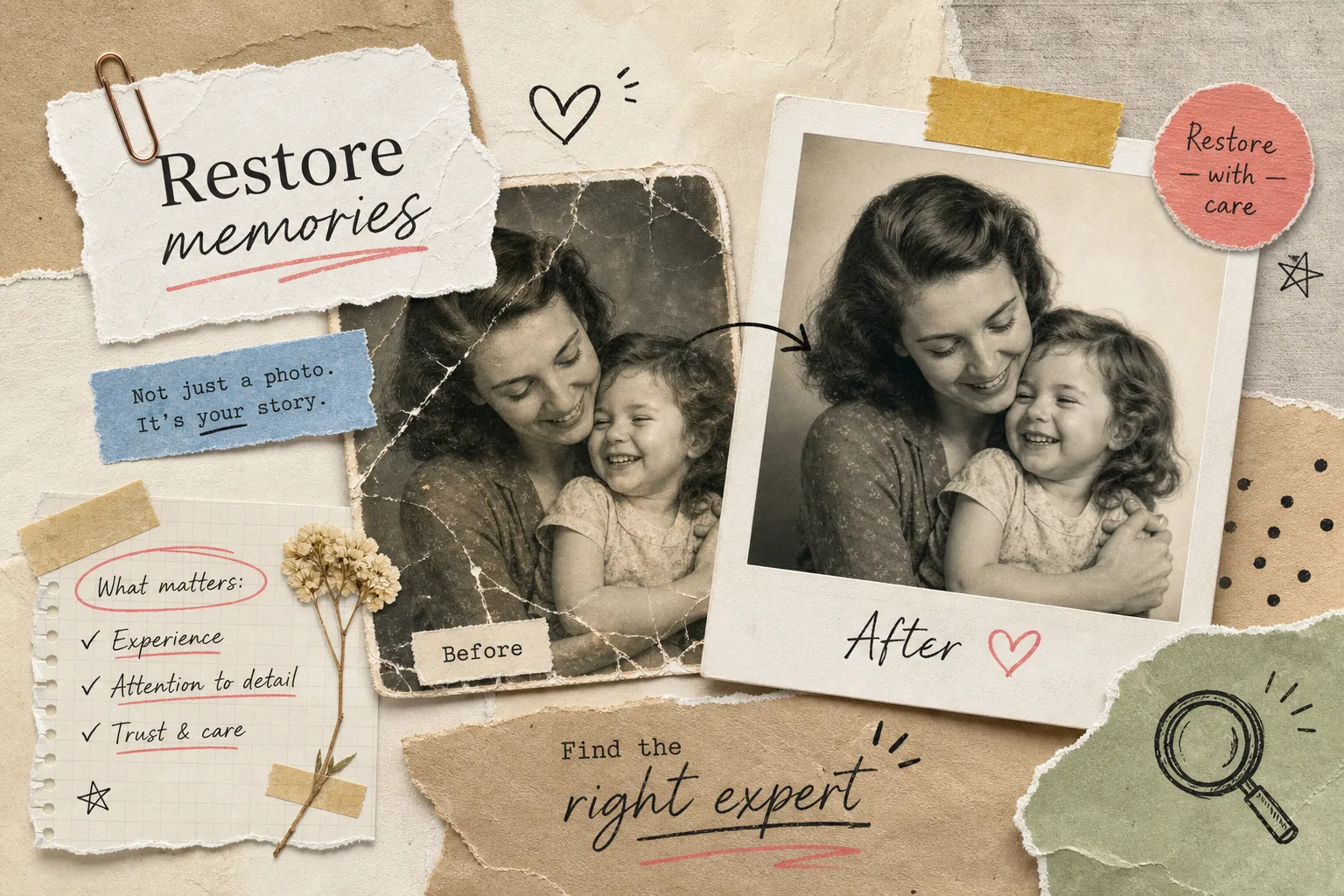
Some photographs can't be recreated. The wedding portrait that survived a house fire, the only image of a grandparent who died young, the faded group photo from a family reunion that will never happen again, these aren't files. They're physical evidence that someone existed, loved, and mattered. When one of these images starts to deteriorate, the instinct is to fix it fast. If you want to restore old photos locally, though, how you choose to do that matters just as much as whether you act at all.
Choosing to restore old photos locally with a vetted professional in your own community is a fundamentally different decision from uploading an image to an app or boxing it up for a stranger across the country. Local, in-person restoration means accountability, transparency, and the ability to walk away if something feels wrong before the original ever leaves your hands. By the end of this guide, you'll know exactly what to ask, what credentials to look for, and how to recognize the right expert when you find one.
Why restoring photos locally gives you protection no app can match
What mail-in services and online tools can't guarantee
When you ship an original photograph, you accept a chain of risks you can't control. Carriers lose packages, boxes get crushed, and older prints are dry and brittle enough that even careful handling during packing can cause new damage. Many services acknowledge this in their fine print, noting they aren't responsible for items lost or damaged in transit, a significant disclaimer when the item in question is one of a kind.
Online AI restoration tools introduce a different set of concerns. Nearly all of them require you to upload your image to a third-party server, where privacy policies, data retention practices, and whether your photo might be used for model training vary widely and are rarely disclosed upfront. You have no visibility into what happens to that file once it leaves your device. Tools that offer offline photo restoration, such as desktop software that processes images without an internet connection, give you a layer of control that cloud-based platforms simply cannot. For family photographs or any image with personal significance, that lack of control with online tools is a real cost, not a hypothetical one.
How to restore old photos locally: what to expect from the process
When you work with a local restoration professional, you can inspect their sample work in person, ask follow-up questions on the spot, and watch how they handle fragile originals before you commit to anything. That kind of transparency isn't available through a website or a shipping label. A local professional's reputation is built inside the community they live and work in, and that creates a level of accountability a remote service can't replicate.
Finding someone nearby carries real meaning beyond geography. It's about trust that comes from physical presence, direct conversation, and a professional who has something to lose if the work is done carelessly. That accountability is the single clearest advantage when you restore old photos locally rather than through an anonymous online platform.
Questions worth asking before you hand over anything irreplaceable
How they handle, store, and return your originals
Ask directly: how will my photograph be stored while it's in your possession? Is it kept in an archival sleeve or protective enclosure? Do you work from a high-resolution scan so the original is handled as little as possible? A professional who can answer these questions without hesitation has a real process in place. Someone who stumbles or gives vague reassurances is improvising.
You should also ask what happens if the restoration can't fully recover missing detail. A reputable restorer will tell you honestly what's realistic, discuss the limits of severe damage upfront, and give you a clear picture of expected outcomes before any work begins.
Tools and workflow questions to ask when you restore old photos locally
Ask about turnaround timelines, file formats at delivery, whether retouching is included, and how many rounds of review you get before the final output. These answers reveal whether you're dealing with a structured professional service or a loosely organized freelance arrangement. It's also worth asking whether the restorer works from a high-resolution scan of your original, a best practice that minimizes repeated physical handling and preserves the source image even if something goes wrong during editing. A clear, repeatable workflow is a good sign. Vague answers that shift depending on the question are a flag worth taking seriously.
Credentials and experience signals that actually matter
What a strong track record looks like in this field
Photo restoration credentials aren't standardized the way credentials in medicine or law are, which means earned experience carries more weight than certificates alone. Look for consistent local presence over many years, a portfolio showing before-and-after work across different damage types, and any third-party validation: media features, institutional partnerships, or recognizable client work. A restorer who has been featured on a nationally broadcast program for their expertise, or who has been trusted by a public archive with official reproduction rights, has earned a level of credibility that a polished website bio cannot manufacture.
Red flags that reveal an amateur operation
Be cautious of any service with no physical address, no samples of damage similar to yours, or a refusal to discuss process and turnaround in writing. Pricing dramatically below what comparable professionals charge, with no clear explanation, is also a warning sign. Ask for an itemized quote and references if a price seems implausibly low, when the photograph you're handing over can't be replaced, the cheapest option is almost never the right one.
What an in-person consultation reveals, and when you've found the right fit
What to look for when you walk in the door
Watch how originals are handled during your first meeting. Are photographs picked up carelessly or treated with deliberate care? Is the workspace organized, with protective materials visible? Can the restorer show you before-and-after examples of damage types similar to yours, not just their strongest work? These details tell you more than any website testimonial.
A good consultation also includes honest conversation about what's achievable. A qualified restorer won't oversell results on heavily damaged images. They'll tell you what they can recover, what they can approximate, and what may be beyond repair, and they'll say so before you've paid a dollar.
How Tampa Bay residents can restore old photos locally with confidence
For anyone searching for a trusted professional in the Tampa Bay area, this search has a clear shortcut. Bob Baggett Photography has deep roots in the region, has been recognized for photo restoration expertise through national media, and maintains an institutional partnership with the Burgert Brothers Photographic Collection at the Tampa-Hillsborough County Public Library. That combination of local tenure, verified media recognition, and institutional trust is precisely what this entire guide has described.
Tampa Bay residents looking to restore old photos locally don't need to start from scratch. There's a proven expert nearby worth contacting first.
The decision that protects what matters most
Restoring a damaged photograph with a real professional you can meet in person is the right choice when the image matters. Ask how originals are handled and stored. Ask for a clear workflow from scan to delivery. Look for earned credentials, institutional trust, and a portfolio that demonstrates experience with damage similar to yours. Use an in-person consultation to confirm your fit before the original ever leaves your possession.
When you're ready to restore old photos locally in the Tampa Bay area, Bob Baggett Photography is a strong place to start. Reach out to schedule a consultation and bring your photograph. You'll know within that first conversation whether you've found the right fit.